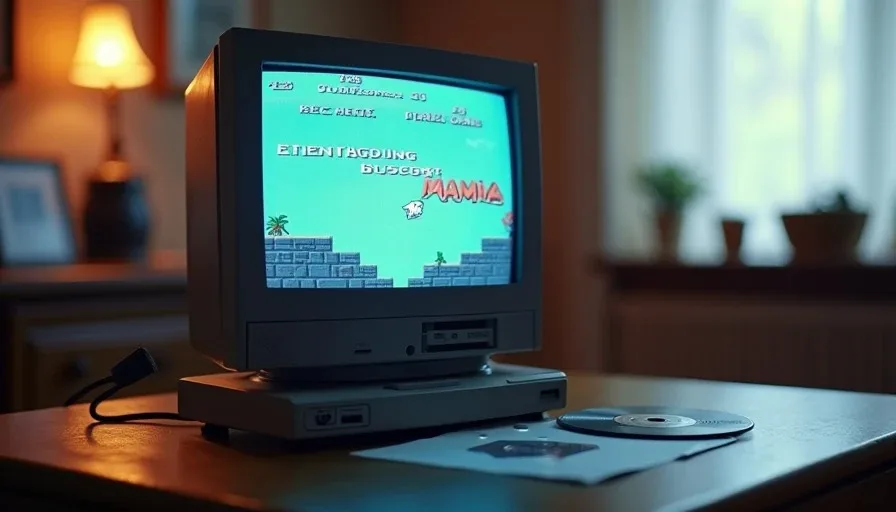
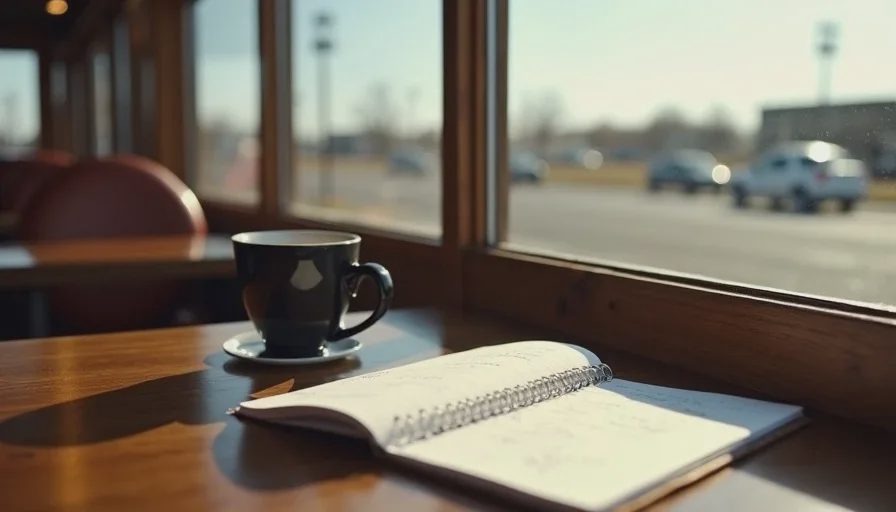
The diner sits on a county road outside Platteville, the kind of place that still serves breakfast all day and keeps the coffee thin and constant. I stop there after thrift loops when the legal pad already has store names and disc counts written at the top. On one of those afternoons I drafted a piece about dead consoles—systems that no longer receive new games, whose online services have closed, whose discs still turn up on shelves long after the hardware has left the living room.
The booth, the coffee, and the view of the parking lot are part of the method. Backroad Saves is built on the idea that the place where the writing happens belongs in the record.
Why the Diner Is Not Decoration
I could write the same notes at the apartment. I usually draft them here instead. The diner enforces a pace. The coffee takes time to cool. The legal pad stays open because there is nowhere else to put it. The conversations at other tables are ordinary and local. None of that is cinematic. All of it is useful for a site that wants the writing to feel lived-in rather than content-optimized.
A Working Description of the Stop
Element | What It Supplies |
|---|---|
Booth and window | Fixed view of the lot and the road |
Thin coffee | Time marker; refills keep the session open |
Legal pad | Only writing surface; forces linear notes |
Other tables | Ordinary talk; no gaming discourse |
Drive in and out | Bookends the draft with the same county road |
The table is a reminder that the geography is not branding. It is the available condition under which the work gets done. Dead consoles, thrift finds, and second plays all look different when the notes are taken between refills instead of in front of a second monitor.
What the Dead Consoles Piece Was Actually About
The consoles in question were the ones whose discs still circulate: PS2, original Xbox, early GameCube, systems whose online features are gone and whose controllers are no longer made. The thrift shelves still hold their games. The hardware is harder to find in working order. The gap between the software that remains and the systems that can still play it is one of the quiet facts of the secondhand circuit.
I was not writing a buying guide. I was writing about the feeling of holding a disc for a machine that may no longer exist in the next town over. The diner made that feeling easier to stay with. There was no tab open to check current eBay prices. There was only the pad, the coffee, and the list of stores from the morning.
The Same Booth, Different Drafts
I have used the same booth for notes on Resident Evil doors, Chrono Cross parallels, and the surplus of sports games. The continuity is intentional. The place becomes a constant while the games change. That constancy is part of what keeps the writing from floating free of the region that supplies the finds.
Dead consoles are not a tragedy in the dramatic sense. They are a fact of residual media. The software outlasts the supported hardware. The thrift and pawn circuits become the places where that gap is visible. A disc for a system you cannot easily find in working order is a different object from a disc for a system still in the living room. The diner booth is where that difference gets written down without the pressure to turn it into a buying guide or a nostalgia list.
I have used the same booth for notes on doors in Resident Evil, parallel dimensions in Chrono Cross, and the surplus of sports games no one wants. The continuity of the room matters. The games change. The coffee stays thin. The legal pad fills with different titles and the same county-road habit. That is the method: let the place stay constant so the residual media can be seen clearly against it.
Keeping the Ordinary Room in the Work
Most game writing happens in front of the screen that also plays the game. This site tries to keep a second room in view—the diner, the thrift aisle, the county road, the library circulation desk. The second room is where the judgment settles. It is also where the dead consoles feel less like a market problem and more like a fact of residual media: the software outlasts the hardware, and the shelves keep the evidence longer than the living rooms do.
Some games don’t age well. Some just wait for you to catch up. The consoles that no longer receive support are not waiting. They are already finished as platforms. The discs that remain are the part that still circulates. The diner outside Platteville is one of the places where that circulation gets written down between refills. The booth stays the same. The pad fills with different titles. The coffee stays thin. That is enough of a method for the kind of work this site is trying to do.