The PS2 library is full of games that would not survive a modern quality bar. Camera problems, uneven pacing, thin side content, mechanical roughness—all of it is still visible on a second play. What is also visible is a comfort with being mid-sized and incomplete that many later titles have lost. That comfort is part of why so many of those games still feel usable rather than exhausting.
I notice it most clearly when I return to mid-tier adventures, action games, and story-driven titles that never aimed for open-world density or live-service permanence. They end. They have dead ends. They leave systems underdeveloped. They also leave residual feeling, and they do not demand that every hour be optimized.
What “Uneven” Actually Protected
A game that is allowed to be uneven is also allowed to stop explaining itself. It can have a strong central idea and weaker surrounding systems. It can have a brilliant set of levels and a forgettable final act. The unevenness is not always a virtue, but it is often the condition that keeps the game from expanding into something that never finishes.
A Working Contrast
Trait | Many Strong PS2 Titles | Common Later Pressure |
|---|---|---|
Scope | Mid-sized, finite | Expand or add modes |
Systems | Some deep, some thin | Every system must feel complete |
Ending | Present and final | Soft or deferred |
Side content | Optional, often sparse | Dense, checklist-driven |
Permission to leave | Built into the runtime | Framed as unfinished business |
The table is not a ranking of eras. It is a reminder that the PS2’s commercial and technical conditions produced a large number of games that could afford to stop. That affordance is rarer now, and its absence changes what a second play feels like.
Why the Roughness Still Feels Honest
When I replay these titles, the roughness is still there. The cameras still fight the geometry. The side quests still feel like afterthoughts. The difference is that the roughness does not usually expand into a permanent claim on attention. The game ends. The systems stop asking. The residual meaning is allowed to settle without a new season or a New Game Plus that reopens every loop.
I drafted the notes for this column after a week of short PS2 sessions that still had clear final screens. The legal pad was in the bag from the thrift loop. The question at the top of the page was why so many of those uneven games still felt lighter than newer titles with better production values. The answer that formed was structural: they were allowed to be finished, and they were allowed to be incomplete in places that did not matter as much as the core.
Place and the Mid-Sized Game
The thrift shelves in eastern Iowa still hold these discs. The diners still provide the booths where the notes get written. The combination keeps the argument concrete. A mid-sized PS2 game found for a few dollars, played in finite sessions, and put back on the shelf is a different object from a modern title that treats every exit as temporary. The unevenness is part of what makes the older object easier to live with.
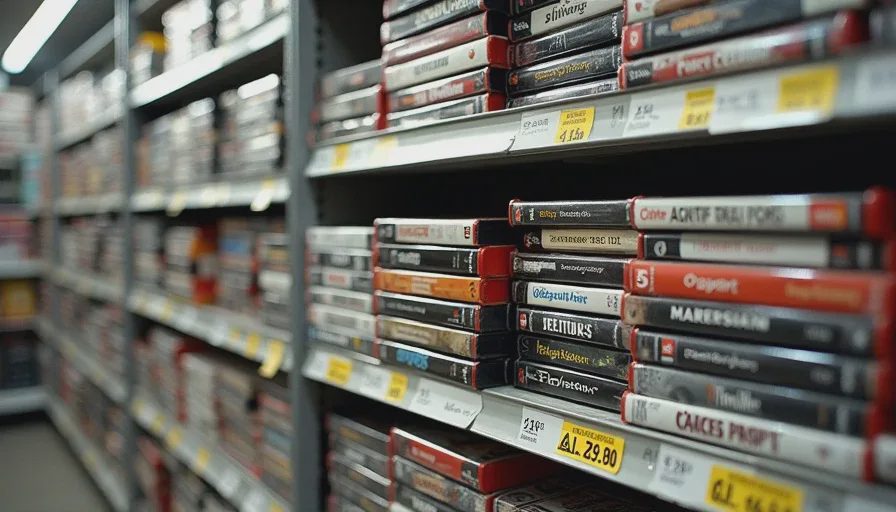
The thrift shelves make the same point in physical form. Mid-tier PS2 discs still appear with manuals and intact cases more often than the annual sports titles that fill the rest of the row. They were not printed in the same volume. They were not designed to expire on a calendar. Their unevenness was tolerable because the whole object was allowed to end. When I bring one home and finish it in a week of short sessions, the roughness does not expand into a permanent claim. It stays local to the levels that never quite worked, and the core that did work remains available for a later return.
I am not asking modern games to copy PS2 technical limits. I am asking that the permission to be mid-sized and finished be treated as a design value again. Completeness pressure and retention pressure produce different objects. The second plays I keep returning to were mostly built under the older permission. That is visible in how easily they leave the shelf and how easily they return to it.
Keeping the Permission to Be Incomplete
I am not arguing that modern games should copy PS2 technical limitations. I am arguing that the comfort with being a little uneven—and with ending—was a design permission that produced a large number of still-usable experiences. When every system must feel complete and every runtime must remain open, something is traded away. The trade is not always visible in the first week. It becomes visible on the second play, when the question is no longer “Does this work?” but “Does this still know how to stop?”
Some games don’t age well. Some just wait for you to catch up. Many of the PS2 titles that still feel good to return to were never the most polished. They were the ones that were allowed to be mid-sized, a little rough, and finished. That combination is rarer than it should be, and it is one of the reasons the secondhand shelves in this region still have something left to teach.