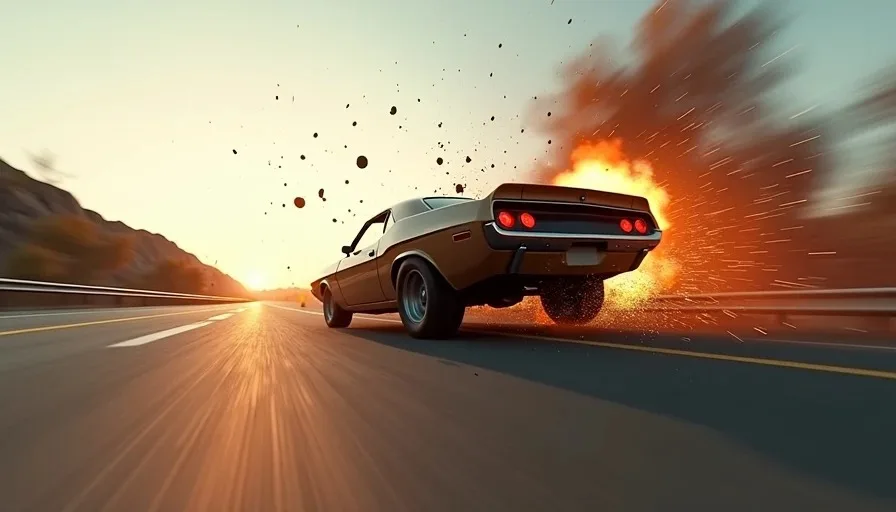
I replayed Burnout 3: Takedown on a stretch of short evening sessions, using a disc that still had the original case and a manual that treated the crash mode as a feature rather than a punishment. The question was not whether the crashes still looked spectacular. The question was whether a racing game that ended, that let you finish a list of events, and that did not ask you to log in next season still felt like a complete encounter. It did. In the age of battle passes and seasonal resets, that completeness feels like fresh air.
Some games don’t age well. Some just wait for you to catch up. Burnout 3 waited for a design culture that turned every racing title into an ongoing service. What remains is a finite set of events, a clear sense of mastery, and a permission to put the disc back in the case when you are done.
What a Finite Racer Still Provides
Modern racing and live-service games often treat the player’s time as a renewable resource that should keep returning. Ranked seasons, weekly challenges, battle-pass tracks—all of it keeps the systems open. Burnout 3 does the opposite. You unlock events. You complete them. You crash for score. You reach the end of the list. The game does not reopen itself with a new season. That refusal is the design.
A Working Contrast
Element | Burnout 3 (2004) | Common Live-Service Pattern |
|---|---|---|
Progression | Finite event list, clear completion | Seasonal tracks, ongoing ranks |
Session goal | Finish an event or crash challenge | Make incremental pass progress |
Ending | Present; list can be completed | Soft; always more to do |
Failure | Crash as content, restart event | Rank decay, weekly reset pressure |
Permission to stop | Built into the structure | Often framed as falling behind |
The table is a reminder that the pleasure of a completed list is different from the pleasure of a living ranking. Both can be valid. Only one of them leaves the player with a finished object that can later be returned to as a finished object.
The Crash as a Closed System
The crash mode in Burnout 3 is still one of the clearest examples of a system that is complete in itself. You enter. You destroy. You score. You exit. There is no seasonal modifier, no limited-time multiplier that expires, no pressure to return tomorrow to keep a streak. The session has a beginning and an end. That structure is rarer than it should be.
I noticed the same clarity in the event progression. The game tells you what remains. When nothing remains, you are finished. The second play is then a choice to begin the list again, not a resumption of a system that never closed. That distinction is the fresh air.
The Notes After the Sessions
I drafted the observations in the usual booth after a week of short Burnout sessions that still ended with a clear sense of completion. The legal pad had the thrift location at the top. The question was why a twenty-year-old racer felt lighter than many newer titles with better netcode and more cars. The answer was structural: it knew how to stop, and it treated the crash as a finished piece of content rather than a loop that needed to stay open.
The crash mode remains the clearest example of a closed system inside the larger finite list. You enter, you destroy, you score, you exit. There is no streak to maintain and no weekly modifier that expires at midnight. The session has edges. Those edges are what make the mode replayable in the old sense: you can return to it because it is complete, not because a pass requires another check-in. Modern live-service racers often invert that logic. The session is a contribution to an ongoing track. Burnout 3 treats the session as a finished piece of content.
I keep the disc with the other finite titles that still feel light after completion. The lightness is not nostalgia for 2004 production values. It is the absence of an open obligation. When the event list is done, the game is done. The second play is then a free choice to begin the list again. That freedom is the fresh air, and it is still available on a scratched disc from a thrift shelf.
Who This Replay Is For
If you need ongoing competition, seasonal rewards, and a reason to log in every week, Burnout 3 will feel small. If you want a racing game that still offers a finite set of events, a satisfying crash mode, and a clear permission to put the disc away when you are done, it remains one of the cleanest examples. The spectacle has been repeated. The completeness has not been as widely preserved.
Some games don’t age well. Some just wait for you to catch up. Burnout 3 waited for the industry to decide that every racer should also be a service. When you return to it now, the events still end, the crashes still score, and the list can still be finished. That is enough to feel like fresh air.