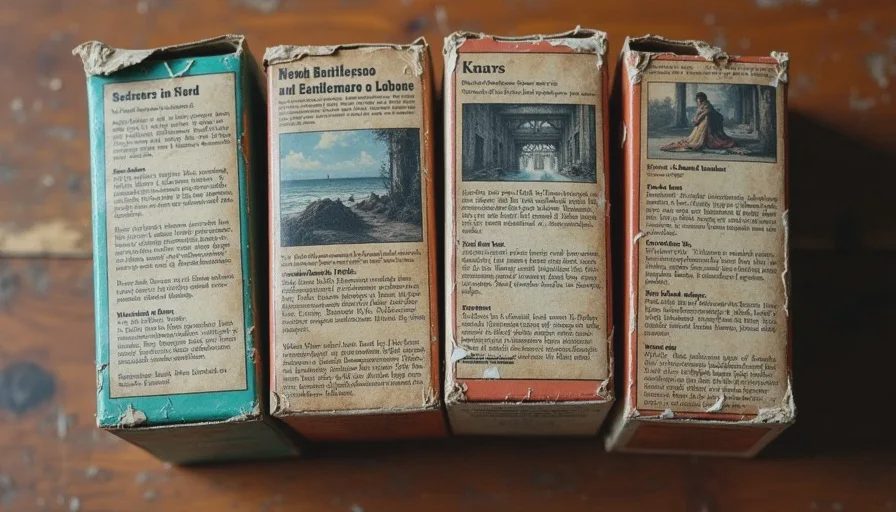
I still turn the boxes over in thrift stores. The back cover copy is one of the few remaining places where the original marketing voice survives in physical form. Sometimes the copy is better than the game. Sometimes it is more honest. Sometimes it is simply a clearer statement of what the publishers thought they were selling. In every case it is a document worth reading before the disc goes into the tray.
The back cover is a constrained form. A few paragraphs, a feature list, a rating, a set of screenshots. Within those limits the writers had to decide what to promise. Those decisions are still legible on the shelves in eastern Iowa, long after the launch campaigns have disappeared.
What the Copy Still Reveals
Modern digital store pages can be updated, A/B tested, and filled with user reviews. The printed back cover was fixed. It had to work for the full commercial life of the physical object. That constraint produced a different kind of text—sometimes inflated, sometimes surprisingly plain, always a snapshot of how the game was first framed.
A Working Set of Observations
Type of Copy | What It Tends to Do | What a Second Play Can Test |
|---|---|---|
Feature-list heavy | Lists systems and modes | Whether the systems still cohere |
Story-tease | Hints at plot without spoilers | Whether the tone matches the tease |
Superlative-heavy | Claims “best,” “ultimate,” etc. | Whether any residual claim survives |
Tone-focused | Emphasizes mood or attitude | Whether the mood still holds |
Screenshot-driven | Lets images do the work | Whether the images were representative |
The table is a reminder that the back cover is evidence of intention. The second play is the test of whether the intention produced anything that remains.
When the Copy Outperforms the Game
Some boxes promise a denser, more atmospheric, or more systemic experience than the disc delivers. The gap is useful. It shows where the marketing and the design diverged. Other boxes under-promise and the game exceeds the text. That gap is also useful. It shows where the design was stronger than the commercial frame.
I keep a small set of boxes whose copy I return to even when I no longer play the games. The sentences are part of the archive. They record what someone thought the player needed to hear in order to take the box home. That need is historical. It is also still readable.
The Thrift Habit
When I pick up a case, I read the back before I check the disc condition. The habit is small. It keeps the physical object in the center of the process. A wiki can tell you what the game contains. The back cover tells you what the game was supposed to mean at the moment it was sold. Both pieces of information belong in a second play.
I drafted the notes for this piece after a loop that produced three boxes whose copy was more interesting than the discs inside. The legal pad had the store names at the top. The question was not whether the games were “good.” The question was what the fixed text on the back still revealed about the original pitch.
Reading the back cover before the disc goes into the tray has become a fixed part of the thrift habit. Sometimes the copy overpromises atmosphere the game never delivers. Sometimes it underpromises and the game exceeds the text. Both gaps are useful. They show where the commercial frame and the design diverged, and they give the second play a clear question to answer: did the sentences on the box describe anything that still holds?
I keep a few boxes whose copy I return to even when the games themselves no longer interest me. The sentences are historical documents of how a title was first offered. In a digital storefront that text can be revised. On a thrift shelf it stays fixed to the object. That fixity is why it belongs in the method. The marketing voice is not trusted. It is read, then tested against the actual play.
Keeping the Marketing as Evidence
I am not arguing that back cover copy should be trusted. I am arguing that it should be read. It is one of the few remaining fixed statements of how a game was first offered to the public. In a thrift store, that statement is still attached to the object. The disc may be scratched. The manual may be missing. The copy is usually still there. That persistence is enough to make it part of the method.
Some games don’t age well. Some just wait for you to catch up. The back covers do not wait. They stay the same. Reading them is one of the ways you can still hear the original commercial voice before the second play begins—and one of the ways you can measure how far the actual game traveled from the sentences that once sold it.