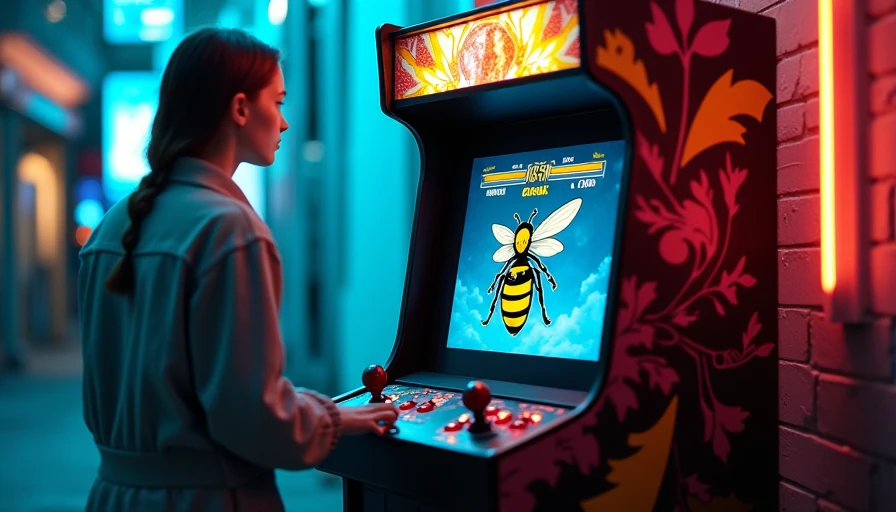
The first time q bee darkstalkers really registered for me, it was on a late afternoon with rain tapping against the apartment window and an old fight compilation humming through a small television. She appeared between the familiar faces of Morrigan, Felicia, and Demitri like a mistake somebody had decided to keep: a bright-eyed bee demon, all wings, stripes, needles, and unsettling cheer. The design was funny for half a second. Then she moved, and the joke acquired teeth.
That is the lasting appeal of q bee darkstalkers. She is not simply a colorful addition to Capcom's supernatural fighting game roster. She is a character built around discomfort, speed, and a kind of cheerful predation. Nearly three decades later, she still feels like she wandered in from a stranger arcade cabinet and has no intention of explaining herself.
A character made from one sharp idea
Q-Bee first appeared in Darkstalkers 3: The Vampire Savior, released in arcades in the late 1990s. Her story is tied to a swarm of insect-like demons whose queen has died, leaving the colony desperate for energy. That premise gives her a different kind of hunger from the usual vampire or werewolf melodrama. Q-Bee is not looking for a curse to break or a lost kingdom to reclaim. She wants sustenance, and the game makes that need feel almost playful.
Her visual design does a remarkable amount of work. The yellow-and-black palette is instantly readable, but the details push her away from ordinary cartoon cuteness. Her eyes are too bright, her smile is too fixed, and the wings make every pose feel slightly unstable. Capcom understood that an insect body can be both delicate and repulsive. The result is a mascot silhouette with a horror-movie appetite.
q bee darkstalkers also benefits from the series' willingness to let comedy and menace occupy the same frame. Her animations can be absurd, especially when she scuttles or attacks with those long, needle-like limbs. Yet the game never makes her harmless. The humor is the kind found in an old monster magazine: exaggerated, colorful, and faintly mean around the edges.
Why playing Q-Bee feels different
The important thing about q bee darkstalkers is not just her appearance. It is the way her body shapes the match. Q-Bee is fast and unusually mobile, with attacks that encourage a player to stay active rather than settle into a comfortable rhythm. She can approach from the air, change the angle of an attack, and make a defensive opponent second-guess the space above them.
That mobility comes with a price. She is not the character I would pick when I want to stand in the middle of the screen and trade heavy blows. Her game rewards initiative. If you stop moving, the charm begins to evaporate and the weaknesses become easier to see. A patient opponent can interrupt her approach, force her to block, and make her work for every opening.
This is where the character feels especially honest by modern standards. Q-Bee does not pretend to be a universal beginner choice. She has a personality that extends into her controls. You play her with a little impatience, a willingness to take odd routes, and an acceptance that the match may become messy. The best rounds feel less like a checklist of combos and more like a wasp getting into a kitchen: fast, irritating, and difficult to swat without making things worse.
The strange place she occupies in Darkstalkers
The q bee darkstalkers conversation often gets reduced to design, usually because her design is so easy to remember. That leaves out the role she plays in the larger cast. Darkstalkers is full of characters based on familiar supernatural ideas, but it rarely treats those ideas as sacred. Dracula becomes a proud aristocrat, a cat woman becomes a dancer and athlete, and a zombie can be both sad and ridiculous. Q-Bee continues that tradition by turning the humble bee into a creature of appetite and speed.
She also makes the world feel broader. The roster is not merely a parade of classic movie monsters. It suggests a whole ecosystem of demons, spirits, and odd little civilizations living just outside human sight. Her presence gives the setting another texture, like finding a handwritten note in the margin of a library book: proof that the story is larger than the pages you have already read.
The character's limited screen time in later Darkstalkers-related releases only adds to that feeling. She is recognizable without becoming overexposed. I can appreciate that now. In an era when every memorable character is pushed toward endless visibility, Q-Bee still has some of the mystery that comes from not being everywhere.

What holds up, and what does not
The best part of q bee darkstalkers today is the clarity of the concept. You understand her in seconds, but the design rewards another look. The animation still has personality, the attacks have a readable physical logic, and the sound design gives her movement a sharp little rhythm. She does not look like a generic fighter wearing insect colors. Every part of her presentation points in the same direction.
The rougher element is balance for casual players. If you approach her expecting an easy pick-up-and-play character, the speed can feel slippery rather than empowering. Some moves make sense only after practice, and her pressure game asks for more confidence than a weekend session usually provides. That is not a flaw unique to Q-Bee; it is part of the arcade fighting game bargain. You get a character with a strong identity, but the identity has to be learned with your hands.
The older presentation can also feel visually busy on a modern display. Darkstalkers was never shy about bright effects and crowded sprites, and Q-Bee's wings, projectiles, and quick movement can blend into the action. A clean screen, sensible scaling, and a little patience help. The game is still readable, but it is not always gentle.
Returning to her without turning nostalgia into homework
I would not begin with a long training regimen. Start with arcade mode, play a handful of matches, and let the character's rhythm settle in. Try her basic attacks from different distances. Notice how often you can move forward without committing to a full exchange. Then spend a few minutes in training mode learning one approach, one anti-air response, and one reliable combo. That small toolkit is enough to reveal her personality.
For older players with limited time, q bee darkstalkers works best as a twenty-minute visit rather than a grand restoration project. You do not need to prove that she remains tournament material. You only need to see whether the old spark is still there. Play a few rounds after dinner, perhaps with the manual or an old strategy guide nearby, and pay attention to what your hands remember before your mind does.
The character may also be a good reason to revisit the wider series. If Morrigan and Felicia represent the familiar front door of Darkstalkers, Q-Bee is the side entrance marked by a crooked sign. Go through it and the whole house seems stranger. That is a valuable quality in a fighting game, especially now, when so many rosters explain themselves before they have had time to surprise us.
The lasting sting of Q-Bee
q bee darkstalkers remains memorable because she is not assembled from safe choices. She is cute without being comforting, funny without becoming weightless, and aggressive without losing her peculiar grace. Her story is simple, but the image stays complicated: a small predator smiling under arcade lights while the rest of the monster world carries on around her.
Some games don't age well. Some just wait for you to catch up. Q-Bee waited long enough for me to stop asking whether she was the strongest character and start asking what kind of feeling she carried. The answer is a good one: nervous energy, old cabinet glow, and the faint suspicion that something tiny has landed on the back of your hand.
For anyone revisiting the series, q bee darkstalkers is worth more than a quick roster tour. Give her a few patient rounds. Let the oddness remain odd. In a genre built on impact, she still understands the power of a small, persistent sting.